FEDERICO SOLMI
THE GREAT FARCE AT THE BLOCK MUSEUM
Northwestern University, Chicago, IL
September 19 – December 1, 2024
FEDERICO SOLMI
Federicio Solmi's carnivalesque critique of our world comes at a time when it is hard to discern what is true or not true. Highlighting the contradictions and fallibilities that characterize our time, his satirical commentary on power, politics, religion, celebrity culture, and consumerism is poignant. By merging his paintings with game engine aesthetics, Solmi’s videos confront the audience with his own absurd rewriting of past and present, merging dark humor and a sense of the grotesque with new technologies.
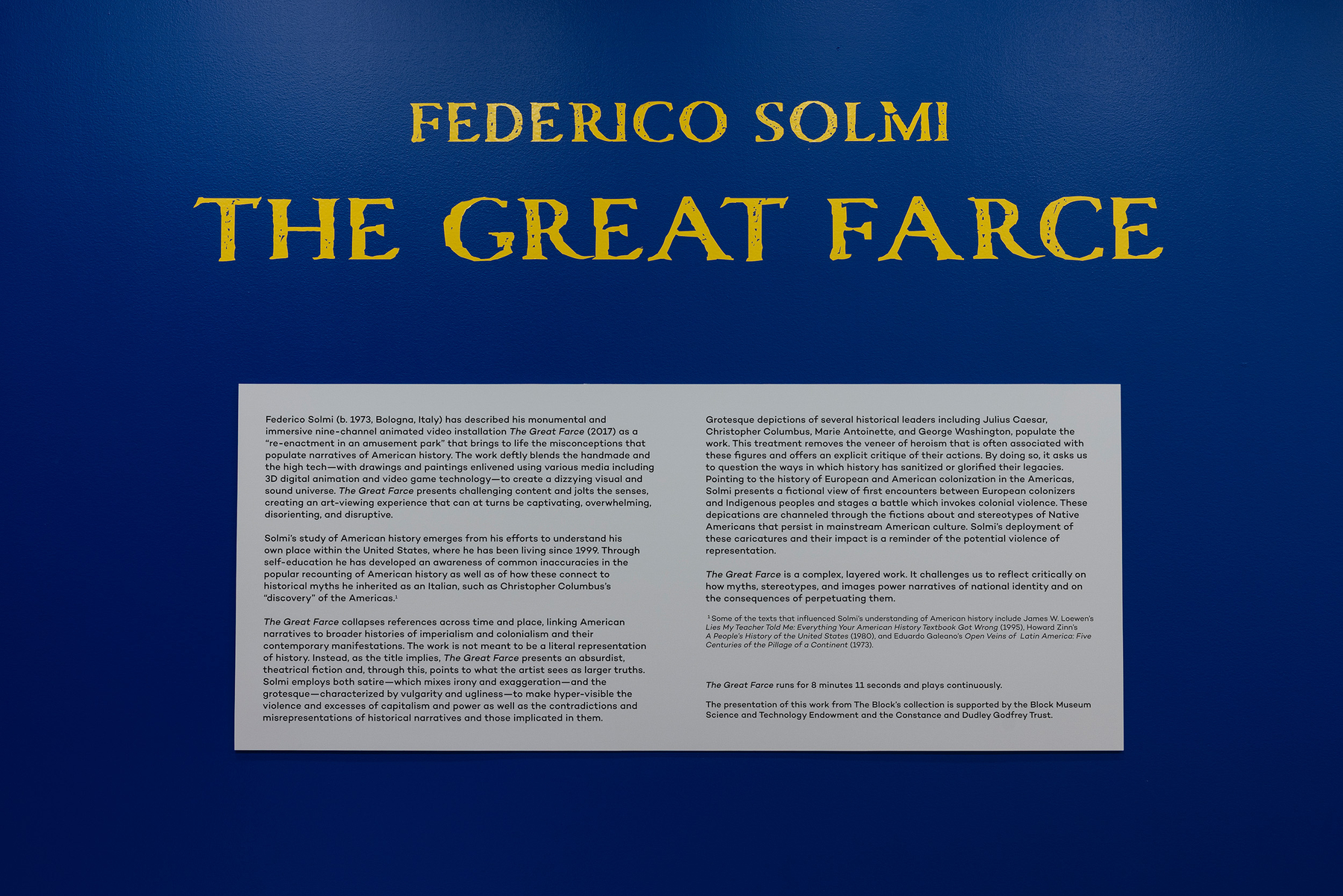
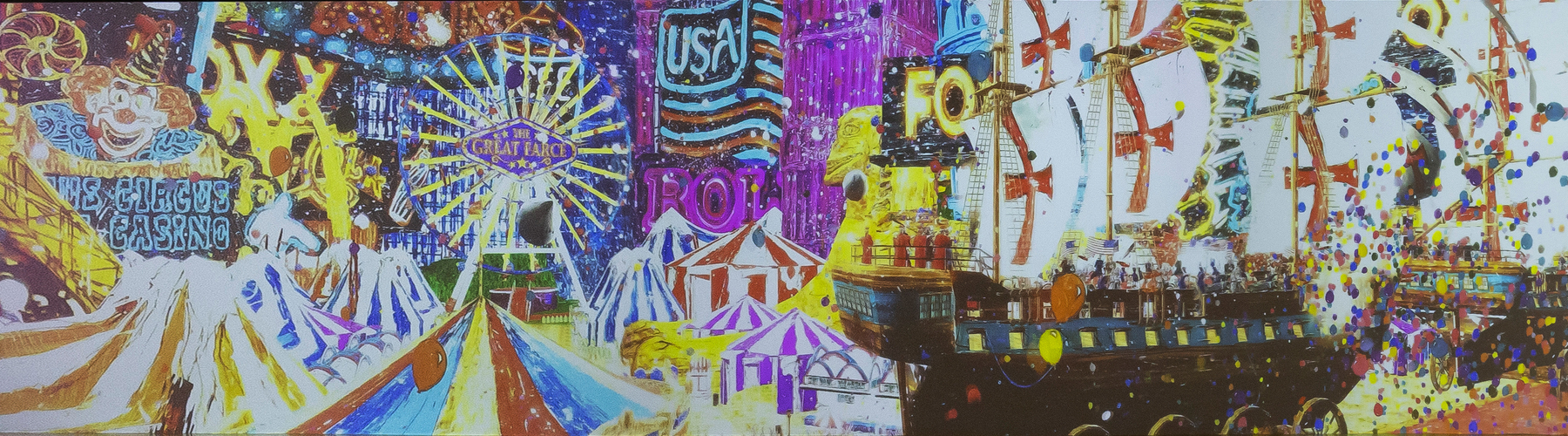
"I decided to mix historical material with different figures— great heroes that are sometimes villains. I did a comparison with the creation of celebrities in contemporary society. There is a sense of spectacle, a mix of the circus and capitalism. Reality becomes like an amusement park— psychedelic and artificial. I thought that the best way to narrate history was through a contemporary lens; to create a sort of reenactment of history as surreal and absurd, where there is no distinction between truth and myth." - Federico Solmi



Federico Solmi
Mundus Novus Triptych, 2020
Ink on paper
24 x 432 in (61 x 1097.3 cm)
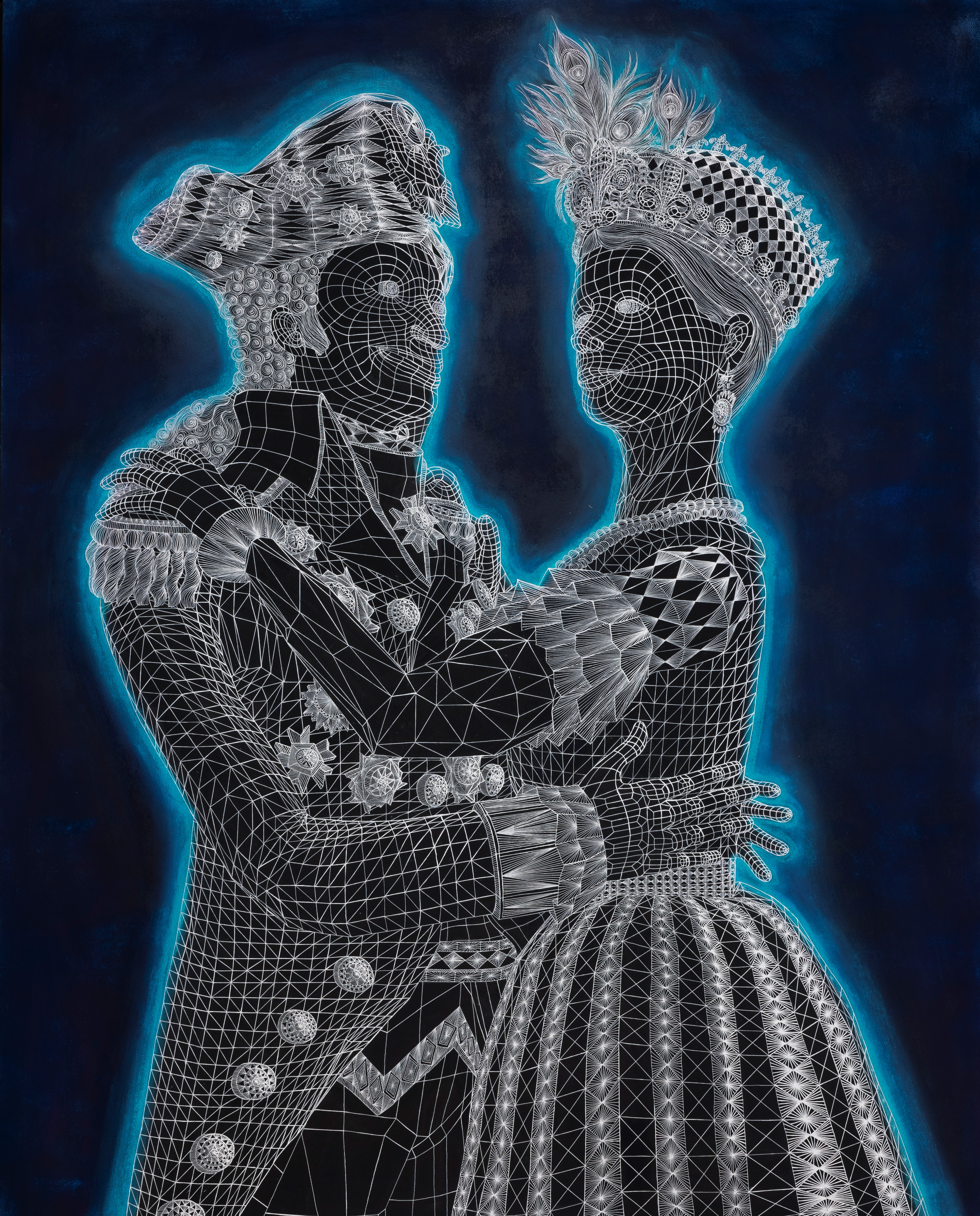
“‘The Great Farce’ is one of Solmi’s most ambitious works in terms of technical complexity, physical scale and scope of content,” said exhibition curator Janet Dees, the Steven and Lisa Munster Tananbaum, Curator of Modern and Contemporary Art. “Throughout his practice, Solmi uses satire, farce and grotesque representations to question the complex relationships between nationalism, colonialism and consumerism. We hope ‘The Great Farce’ will open space for campus- wide discussion around many topics, including the use of satire as a form of social critique, and how popular culture can be a vehicle for reinforcing stereotypical and mythologized narratives of American history.”
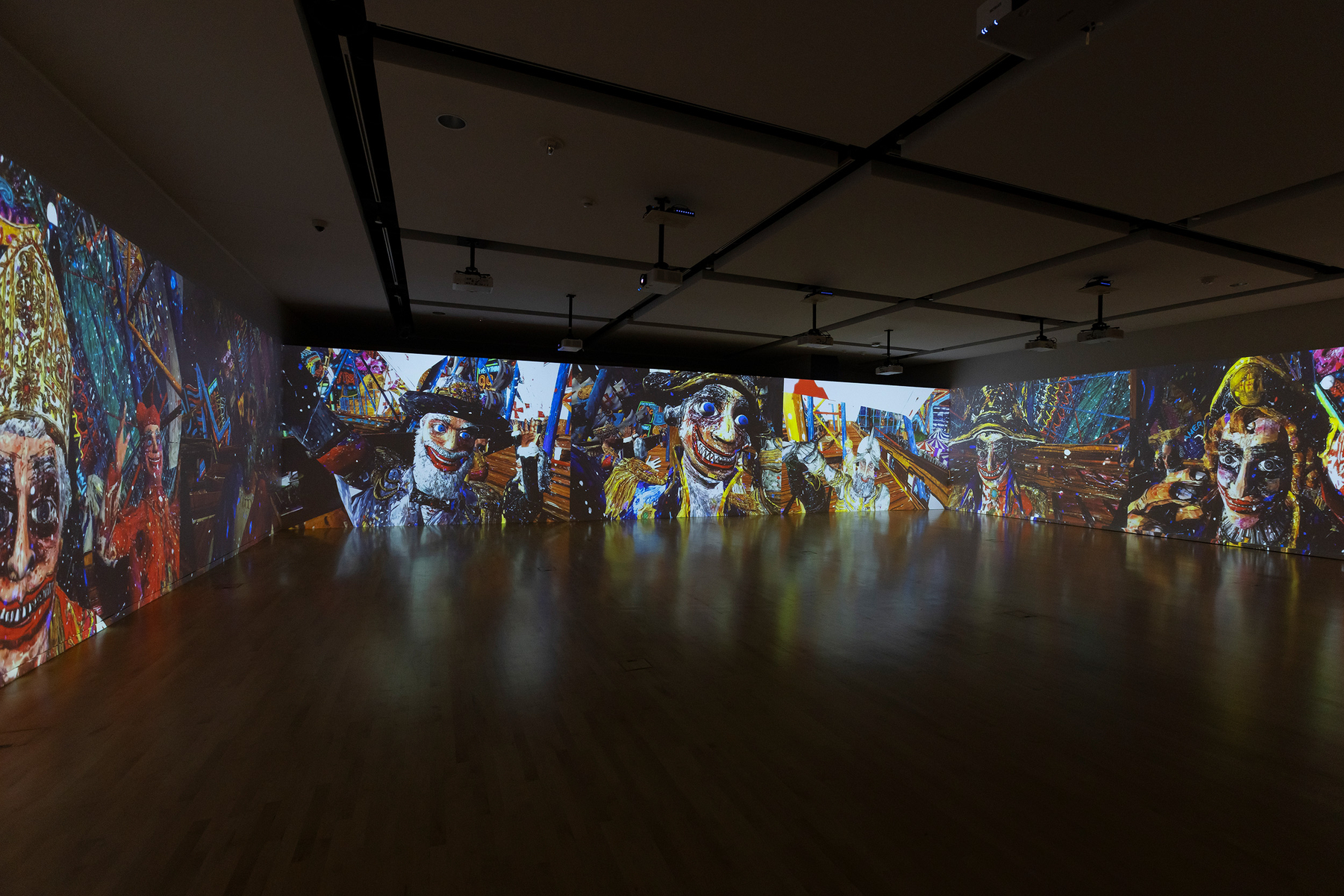
The first question I asked myself in making this work is “what is history?” In the book A World Restored(1957) Henry Kissinger states that history is the memory of states. On the contrary, Howard Zinn believed that history is the memory of the people. In A Peoples’ History of the United States(1980) Zinn stated that he “prefer[red] to try to tell the story of the discovery of America from the viewpoint of the Arawaks, of the Constitution from the standpoint of the slaves…[i]” I understand that narrating history can be complicated because there are different points of view. You have someone like Kissinger who was an admired statesman saying that history is the memory of the state. I challenge that.
The Great Farce is a tragic-comic account of history in which I metaphorically explore the open wounds of United States history since its conception to the present day. It is a parody of the political arena in the United States in which reality has become a theatrical stage, a spectacle, of conflicting events where there is no more distinction between fact and fiction.
I’m trying to seduce the audience with my point of view through beautiful images. Some of the images could be interpreted as absurd or shocking, or too strong. By seducing the viewer I hope that this will trigger something in them. They may admire the work or hate the work. The idea is that by shaking people up, they may be more receptive to thinking critically about history and about the world that surrounds us.
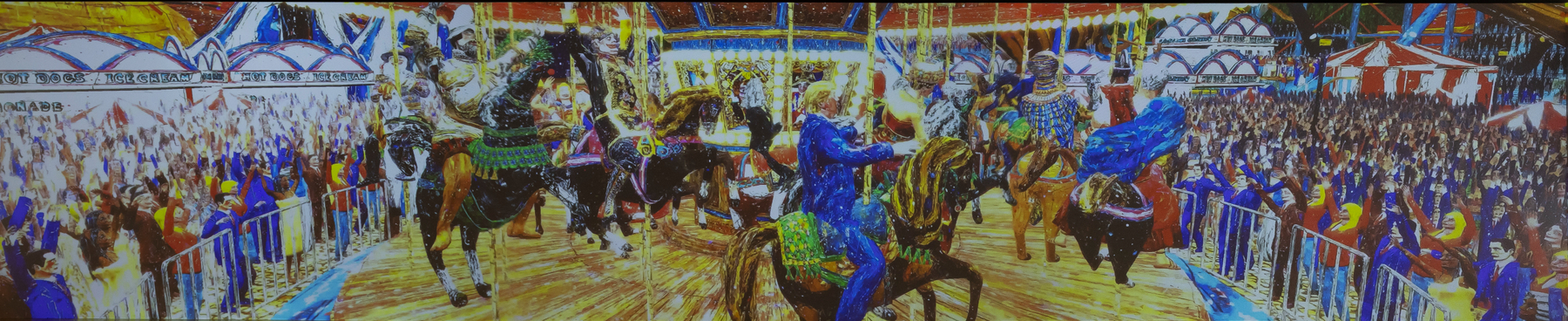
Solmi’s process of creating video animation involves the construction and development of a virtual world within a video game engine. Surface textures and characters are scanned from original paintings and drawings, later applied to 3D-models designed in Maya and ZBrush. Within each designed "game," Solmi uses the first-person view to explore chaotic environment as both voyeur and director. During production the narratives and images continually evolve and are further developed with drawings and storyboards. Various characters' actions are captured in real time with screen recording software, then edited and overlaid with audio compositions. Once exported and assembled, the resulting video-paintings merge seamlessly with the hand-painted frames surrounding each tv monitor. Each project can take up to three years to complete.
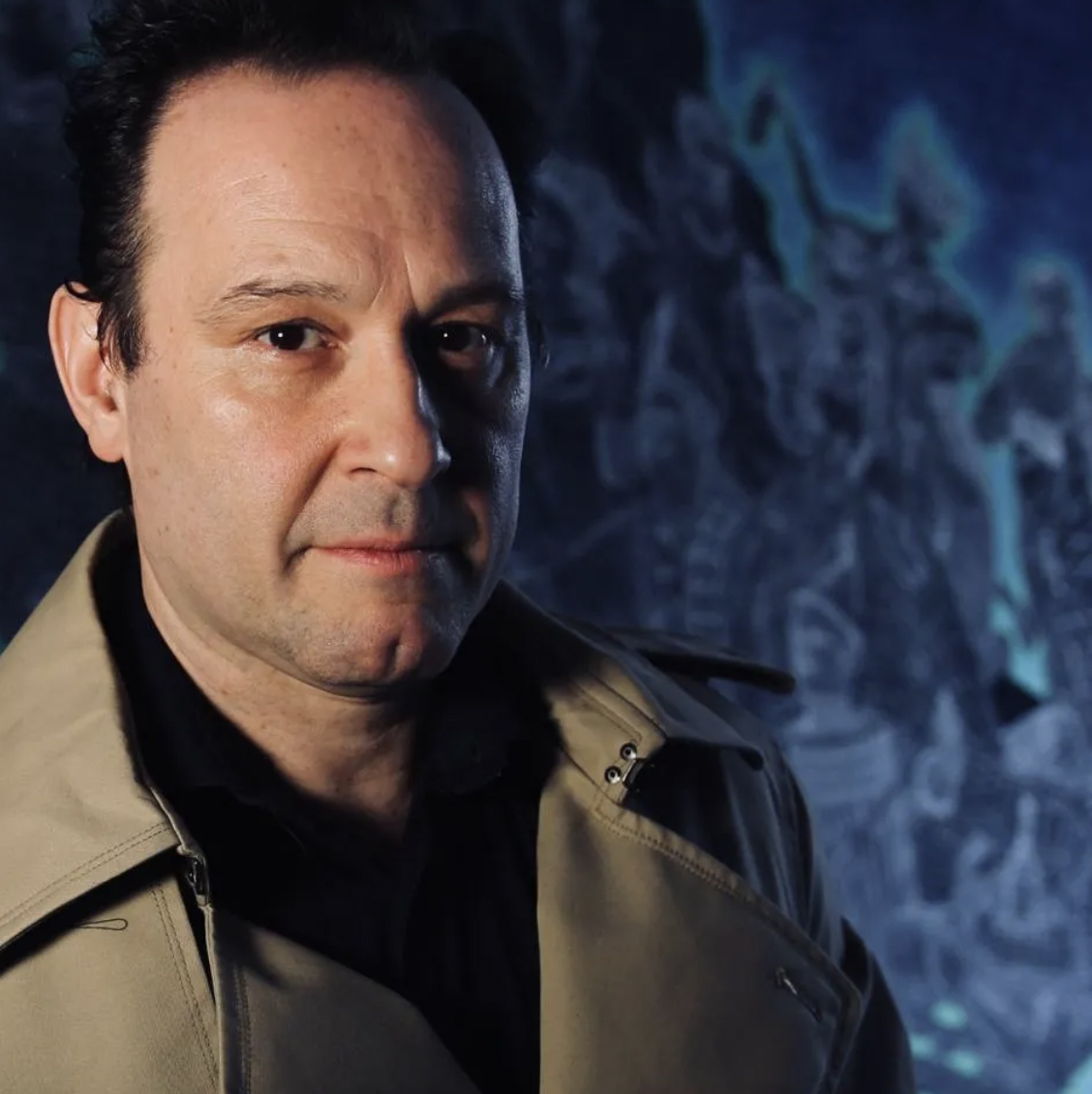
Federico Solmi (b. 1973, Bologna, Italy) is an internationally acclaimed multi-media artist who employs a satirical aesthetic in order to portray a dystopian vision of our present-day society. Combining traditional media, such as drawing and painting, with emerging technologies such as 3D animation, videogame software, and kinetic technology, Solmi's animations playfully and irreverently depict the most loathed and hypocritical aspects of contemporary life and western society through absurd narratives. Solmi stages a virtual world where our leaders become puppets and the absurdity of exploitative action is accentuated, brilliantly animated by computer scripts and motion capture.
Solmi’s animated video series The Evil Empire (2006-2009) provoked controversy and censorship in France and Spain, eventually escalating to a now infamous trial in Italy in which he was charged with and tried for obscenity, blasphemy, and offense to religion. The hand-drawn animation is set in "Vatic-Anal-City" in the year 2046 and portrays the exploits of a fictional pope who is addicted to online porn and predatory sex with priests and nuns. A number of related objects accompanied the series, including a sculpture of a crucifix that features Solmi as the Pope with a large grin and a huge erection. The charges were ultimately dismissed, but the attention from this controversy led to Solmi to receiving a 2009 Guggenheim Fellowship. Other videos and series by Solmi include: The Brotherhood (2015-2018), Chinese Democracy and the Last Day on
Earth (2012), King Kong and the End of the World (2005), The Giant, and Rocco Never Dies (2004).
Recent exhibitions include The Bacchanalian Ones (2020) at Rowan University, Glassboro, NJ; The Great Farce (2019) presented by Times Square Arts’ Midnight Moment across 100 billboards in Times Square; The Great Masquerade (2019), a 20-year survey exhibition at Tarble Arts Center, Charleston, IL
and Kunstkraftwerk, Leipzig, Germany; Open Spaces: A Kansas City Experience (2018), organized by Dan Cameron; The Good Samaritan (2018) at Rochester Contemporary Art Center, Rochester, NY; The Great Farce (2017) at Frankfurt B3 Biennial, a commissioned work presented on monumental digital billboards on the exterior of the Frankfurt Opera House; 2016 Quadrinnale di Roma, Rome, Italy; and the 2015 B3 Frankfurt Biennial, at which he was awarded the Ben Main Prize. Solmi’s work has been exhibited in numerous museums, institutions, and festivals, including: 54th Venice Biennale (2011); 2010 SITE Santa Fe, Santa Fe, NM; Centre Georges Pompidou, Paris; The Drawing Center, New York; Haifa Museum of Art, Haifa, Israel; Haus der Kulturen der Welt, Berlin; Kasseler Kustverein; the Kassel Documentary Film and Video Festival, Kassel; Shenzhen Independent Animation Biennial, Shenzhen, China; National Center for Contemporary Art, Moscow; Reina Sofia and CA2M Centro de Arte de Mayo, Madrid; Loop Barcelona; Australian Center of Moving Images, Melbourne; and Victoria Memorial Museum, Calcutta, India.
His work has been reviewed by publications and media platforms such as Artforum, Art in America, Flash Art Magazine, Frieze, Tema Celeste, Artnet.com, Artillery, Artinfo, Artfacts.net, Art Scene LA, Art Actuelle, Contemporary, Marie Claire, Glamour, L’Espresso, Visual Art Source, The New York Times, Los Angeles Times, KCRW ArtTalk, Le Figaro, Daily News, El Mundo, El Pais, il Giornale, Il Mattino, and La Repubblica.
Solmi’s work is part of many notable collections including The Phillips Collection, Washington D.C.; Block Museum of Art at Northwestern University, Evanston, IL; Tarble Art Center, Charleston, IL; 21C Museum Hotels, Knoxville, TN; Thoma Foundation, Chicago, IL / Santa Fe, NM; OCAT, Oct Contemporary Art Terminal, Shanghai, China; Collezione Farnesina Experimenta, Rome, Italy; Dr. Arturo and Liza Mosquera Collection, Miami, FL; and Collezione Marchina, Milan, Italy.